



For many years, LuciSun did not invest much effort in its website. When the company was created, the priority was not communication or marketing. The priority was to build the technical foundations of the company, develop engineering services, and create the tools and methods that would support our work.
The first version of the LuciSun website was therefore intentionally simple. It was created quickly at the start of the company and remained largely unchanged for several years.
During that time, the team was fully occupied developing projects, collaborating with partners, and gradually building the services, software tools, and research activities that now form the core of LuciSun.
As a small technical team working with a strong network of collaborators and clients, we consistently had more demand than capacity to deliver. Improving the website or investing time in communication therefore remained a secondary priority for a long time.
Today the situation has evolved. LuciSun has grown, our activities have expanded, and we now have more capacity to engage in new collaborations. It therefore felt like the right moment to build a website that better reflects the structure and scope of our work.
This new website is intended to serve as LuciSun’s digital home. It brings together the different aspects of our activity that had previously been distributed across research papers, project reports, internal tools, and collaborations. It also provides a clearer view of the areas of expertise developed within the team, which underpin our work across photovoltaic modelling, solar resource assessment, data analysis, and system optimisation.
The structure of the new website reflects three main pillars of LuciSun’s work: Services, Solutions, and Research and Development. Together, these three areas describe how LuciSun contributes to photovoltaic projects, from engineering practice to digital tools and scientific research.
Services
The Services section presents the engineering activities through which LuciSun supports photovoltaic projects and organisations.
Technical Advisory
This activity covers services such as technical due diligence, solar resource assessment, energy yield assessment, and performance analysis of photovoltaic systems.
Digital Factory
Through Digital Factory, LuciSun develops custom digital tools and modelling solutions tailored to complex energy and photovoltaic projects.
Training and Courses
LuciSun provides professional training in topics such as solar resource assessment, PV simulation, and advanced photovoltaic engineering methods.
Project Proposal Writing
The company also supports organisations in the preparation of research and innovation proposals for national and international funding programmes.
Together, these services reflect the engineering side of LuciSun’s work, built through many years of practical experience in photovoltaic projects.
Solutions
The Solutions section focuses on the software tools and digital platforms developed by LuciSun to support modelling, analysis, and decision-making in solar energy systems.
LuSim
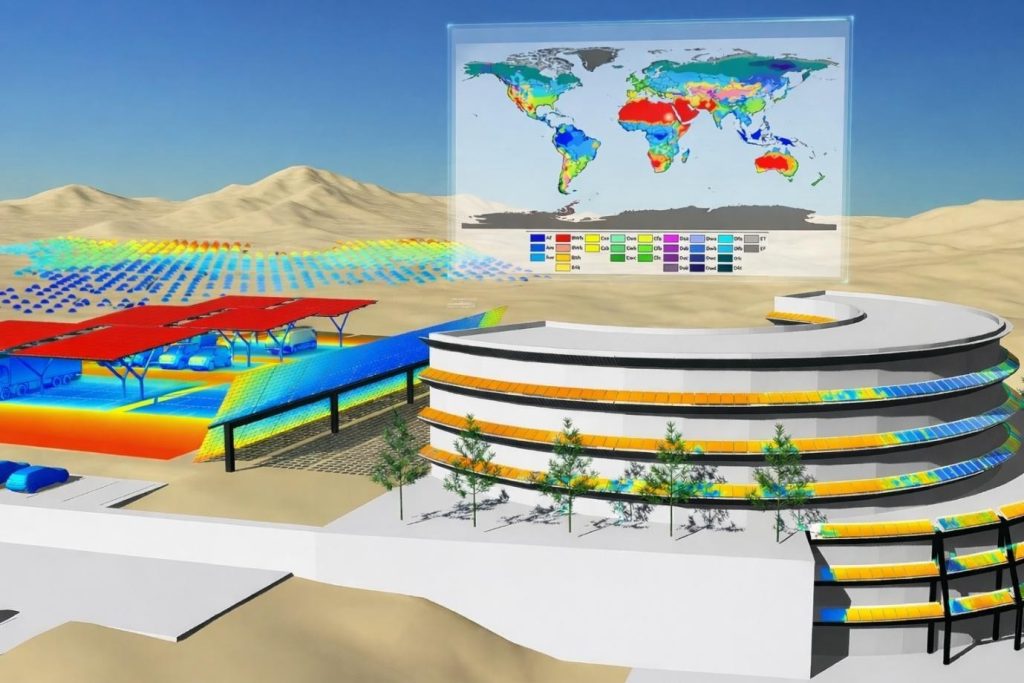
LuSim is the core simulation platform developed by LuciSun for advanced photovoltaic system modelling. It supports detailed simulations of complex PV configurations, including three-dimensional geometries, shading interactions, bifacial systems, agrivoltaics, and uncertainty analysis. It is designed to address modelling challenges that go beyond simplified plane of array approaches.
LuData
LuData provides a platform for accessing and combining solar irradiance data, meteorological datasets, analytical models, and modelling workflows. Through graphical interfaces and application programming interfaces, users can run modelling processes, access curated datasets, and integrate solar and environmental data into automated analysis pipelines. The platform also enables the publication and licensing of datasets and analytical models within a controlled environment.
Consolectiv
Consolectiv focuses on modelling and management tools related to collective energy consumption and energy communities. It supports the analysis of energy sharing schemes and consumption patterns within distributed energy systems.
Together, these tools form a coherent digital ecosystem that can be used independently or combined depending on project needs.
Research and Development
Research has always been a core component of LuciSun’s activity. The Research and Development section of the website presents both the research projects in which LuciSun participates and the scientific contributions produced through these activities.
Research Projects
LuciSun participates in national, European, and international research projects that explore advanced modelling approaches, datasets, and engineering methods for photovoltaic systems. These projects typically combine numerical simulations with experimental measurements, demonstrator data, and operational system performance. This approach helps validate modelling methods under realistic engineering conditions and identify the limits of applicability of different techniques.
Research projects also play an important role in consolidating LuciSun’s technical expertise and in supporting the continuous development of its services and software tools.
Scientific Contributions
Scientific dissemination is an integral part of LuciSun’s research and development activities. Results emerging from research projects and applied engineering work are regularly formalised and shared through peer-reviewed journals, international conferences, and specialised workshops.
This process allows modelling approaches and methodologies to be confronted with external scientific scrutiny, helping clarify assumptions, evaluate uncertainties, and maintain alignment with the evolving state-of-the-art in photovoltaic research.
More broadly, LuciSun’s research activities address recurring technical questions in photovoltaic system engineering. These include topics such as advanced three dimensional modelling of solar radiation and photovoltaic systems, solar resource assessment and measurement quality, uncertainty analysis and propagation, performance data analysis, long term system degradation, and the modelling of complex configurations such as bifacial PV, building integrated photovoltaics, and agrivoltaic systems.
Across these topics, research activities focus on the relationship between modelling complexity, data quality, and decision value in real photovoltaic projects.
A Space to Share Ideas
The launch of this new website also marks the beginning of the LuciSun blog. This space will be used to occasionally share reflections related to photovoltaic modelling, solar resource assessment, PV system design, agrivoltaics, and other topics connected to our work.
Photovoltaic engineering is evolving rapidly, with increasing system complexity, growing data availability, and stronger interactions between research and industrial practice. These developments raise many interesting technical and methodological questions. Through this blog, we hope to document some of these questions and share insights that may be useful for the broader photovoltaic community.
We hope this new structure will make it easier for visitors to understand what LuciSun does and how the different aspects of our work fit together.
 English
  French
  Spanish